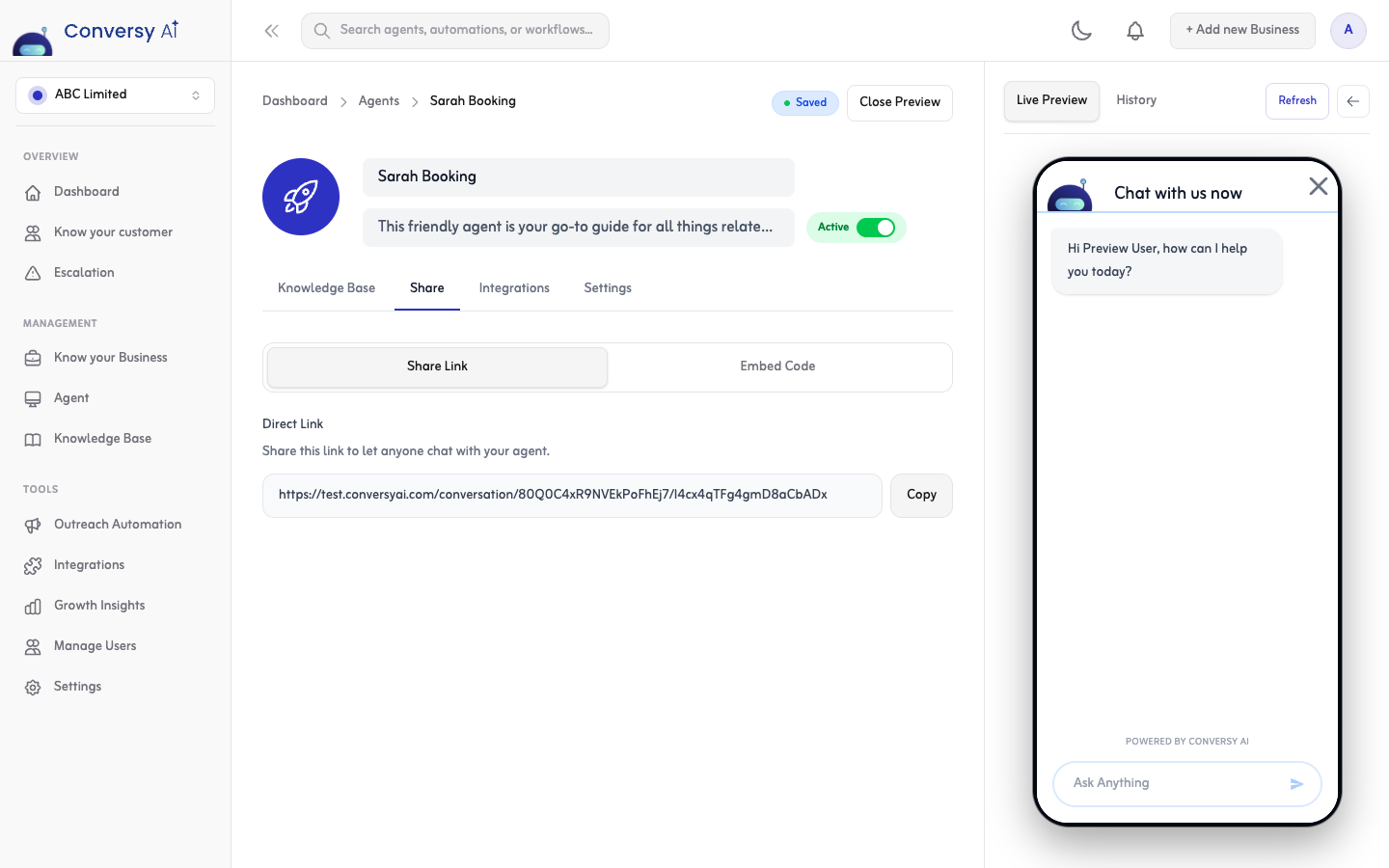
Create, configure, and deploy
A central workspace gives each business a clear view of its agents, their purpose, status, and route into production.
- Multi-step agent configuration
- Business-scoped agent management
- Deployment status and access
A no-code platform for small and medium businesses to configure, ground, connect, and deploy customer-facing AI agents through shareable links and embedded chat.

Teams that need capable customer engagement without building an AI platform from scratch.
Questions, bookings, billing, outreach, and escalation across one coordinated experience.
Explore the interface, the operating model, and the engineering behind it.
See how agent setup, grounded knowledge, business tools, customer history, and operational insight fit together.
A central workspace gives each business a clear view of its agents, their purpose, status, and route into production.
Business content becomes a managed knowledge layer so customer answers stay grounded in the right source material.
Agents move beyond answers by connecting to the services businesses already use for scheduling, payments, messaging, and CRM.
Customer records and conversation context give teams continuity across visits, requests, and outcomes.
Escalations surface conversations that need human judgment, preserving context and making the next action explicit.
Operational and engagement signals turn agent activity into product, service, and growth insight.
Outbound workflows help businesses reconnect with customers through targeted, context-aware engagement.
Product experience, platform decisions, and operating requirements treated as one system.
Every query and resource is scoped through a deliberate tenant hierarchy, keeping one deployment useful across many customers.
Purpose-built agents handle questions, bookings, billing, and other intents while orchestration coordinates complex conversations.
A React experience and NestJS GraphQL API keep product development direct while Firestore models tenant isolation and resources.
Each layer supports the next: an intentional experience, a sound technical foundation, and a product that can evolve.
Define the workflows, information hierarchy, interactions, and visual system around real user needs.
Build the application, data model, integrations, permissions, and operational controls as one architecture.
Use real product signals to refine the experience, expand capability, and reduce operational friction.
Explore the product or talk to INNOVERIC about building your own.